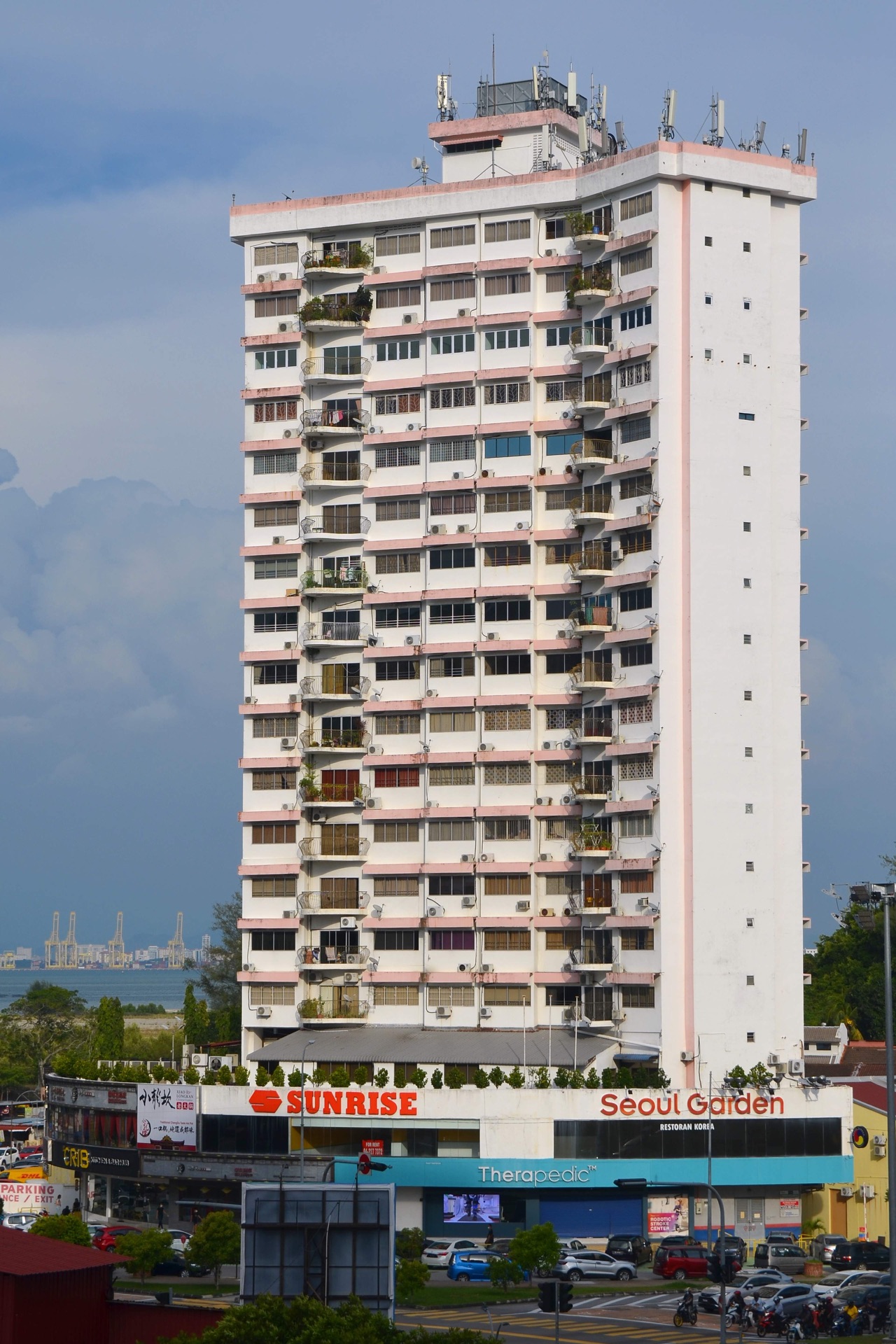
The most-quoted warning about Penang property is that the state is sitting on 3,165 unsold homes. For a foreign buyer, that number is close to meaningless — and the reason is a rule, not an opinion.
Penang's glut sits almost entirely below RM400,000. The minimum a foreigner may legally pay on Penang Island is RM1,000,000. You are barred from the oversupplied half of the market, which means it is not competing with your purchase and will not undercut your resale.
That is the kind of thing this article is about: the case for Penang made from rules and numbers rather than adjectives. It ends with the case against, because there is one.
Key takeaways:
- You hold freehold title in your own name — including landed property, subject to state consent. Malaysia sets no cap on how much of a building foreigners may own.
- Being foreign costs about 11% extra on Penang Island — a 3% state levy plus the flat 8% stamp duty, against the tiered 1–4% a citizen pays.
- Penang's healthcare is an industry, not a brochure line — 527,176 foreign patients in 2025 and RM1.13 billion in revenue, roughly 40% of Malaysia's entire medical tourism market.
- Supply in the corridor you actually want is thin — about 4,436 units completing across the whole northern corridor 2027–2030.
- Penang's property glut cannot reach you. It sits under RM400,000; the foreign floor is RM1,000,000.
What You Actually Get to Own Here
Start here, because everything else is secondary.
A non-citizen buying in Malaysia takes freehold title in their own name. Not a lease, not a use-right, not a company shell holding an asset on your behalf. With state consent, that extends to landed property as well as strata. You can mortgage it, let it, leave it in a will, and sell it on.
Malaysia also sets no per-building foreign quota. There is no percentage of a development reserved for citizens that you have to fit inside — and, just as importantly, no quota that your eventual buyer has to fit inside either. Control happens through two other levers instead:
- a minimum purchase price, set by each state — RM1,000,000 on Penang Island, RM600,000 on the mainland
- state consent, a case-by-case approval that takes three to four months
That structure has a consequence worth thinking about before you look at a single unit. Because the constraint is a price floor rather than a quota, once you clear it your resale pool is everyone else who clears it — foreign or Malaysian. Your exit is not rationed by how many foreigners already own in your building.
I am not telling you this is generous. I am telling you it is ordinary ownership, of a kind that is worth confirming carefully anywhere you buy abroad. Our foreign buyer guide sets out the full process, and if you are weighing Penang against other regional destinations we have Penang vs Phuket and Penang vs Bali — though the ownership rules in any other country change often enough that you should confirm them with a licensed professional in that market rather than taking any property article's word for it, including mine.
What It Costs to Be Foreign Here
Ownership rights are the first question. Transaction cost is the second, and it should be in your model before you shortlist, not after.
On Penang Island a foreign buyer pays:
- 3% state levy on the purchase price
- 8% stamp duty, flat — against the tiered 1–4% a Malaysian citizen pays
- Legal fees, plus three to four months for state consent
Call it roughly 11% above the price before legal fees. On a RM1,000,000 purchase that is RM110,000, and it is real money you will not recover on resale — so a two-year flip is a poor idea here regardless of how the market moves.
The honest way to read that number is as an entry fee for the ownership structure above. It is not trivial, and it is one of the reasons I tell people this is a five-year-plus asset rather than a trade. The full arithmetic, line by line, is in the true-cost guide.
Why Penang Specifically, Not Just Malaysia
Malaysia's rules are national. So the honest next question is why this island rather than Kuala Lumpur, Johor or Kota Kinabalu.
Because the healthcare is measurable. This is normally where a property article says "excellent medical facilities" and moves on. Penang's private hospitals treated 527,176 foreign patients in 2025, up 26% on the 418,608 the year before, generating RM1.13 billion — roughly 40% of Malaysia's entire medical tourism revenue, from one small state. Whatever you think of Penang as a place to live, its healthcare capacity is not an aspiration; it is an export industry with numbers attached. For a buyer in their fifties or sixties, that is the single most under-priced factor on this list.
Because supply in the good corridor is genuinely constrained. Penang Island is small and its premium northern corridor is largely built out. Across Tanjung Tokong, Tanjung Bungah, Gurney, Pulau Tikus, Georgetown and Jesselton, our own records show roughly 4,436 units completing across 2027–2030 — tapering to 128 in 2030. That is not a lot of new stock for the part of the island that foreign buyers actually want.
Because English works. Not as a tourist convenience — in the schools, the hospitals, the law firms and the banks. You can read your own SPA, question your own lawyer, and understand your own management accounts without a translator standing between you and a decision.
Because George Town is a real city, not a resort. UNESCO-listed since 2008, with an economy, a working port, a tech corridor at Bayan Lepas, and residents who live there year-round. Resort markets empty out in the off season and their rental economics follow. Penang does not.
If you want the head-to-heads specifically, we have Penang vs Phuket, Penang vs Bali, and Penang vs KL vs Johor.
The Glut That Cannot Reach You
Here is something I have not seen anyone else point out, and it falls straight out of putting two of our own datasets side by side.
Penang holds 3,165 completed unsold homes — fifth highest of any Malaysian state and up 16% year on year. That number gets quoted at foreign buyers as a warning. It should not be.
The overhang is concentrated below RM400,000: 708 units in the RM200,001–300,000 band and 412 in RM300,001–400,000. The foreign-buyer floor on Penang Island is RM1,000,000.
So the oversupplied segment is one you are legally barred from buying into. It is not competing with your purchase, it will not undercut your resale, and its tenants are not your tenants. A Malaysian buyer at RM350,000 should read the overhang data carefully. A foreign buyer at RM1.3 million is looking at a different market that happens to share a postcode. The full overhang analysis has the segment breakdown.
What RM1 Million Actually Gets You
The floor is a real number, so it is worth knowing what it buys rather than guessing.
At and just above the threshold in the northern corridor, on current asking prices from our own records: Lumina Residence from RM1,030,000 and Waterstone from RM1,287,000 among new launches; Mira Residence from RM1,070,000, Fettes Residence from RM1,139,000 at about RM542 psf for 2,000–2,467 sq ft, and Andaman @ Quayside from RM1,280,000 at about RM1,086 psf.
The spread in that list is the point. Eligible northern stock runs from roughly RM450 to RM1,086 per square foot, so RM1 million buys either a newer, smaller unit or a considerably larger older one. Most foreign buyers arrive assuming RM1 million is a modest budget because it is modest in Singapore or Hong Kong. It is not modest here — it buys 2,000 sq ft if you want it to. The applied shortlist, with ineligible stock stripped out, is in what RM1 million buys a foreign buyer in northern Penang.
And If You Want to Live Here
Buying and residing are two separate questions, and conflating them causes most of the confusion I see.
You do not need MM2H to buy. It is a residence visa, not a purchase permit. What MM2H does is let you stay long-term — and its structure now lines up neatly with property. The programme was restructured under MOTAC in July 2024, the old offshore income requirement was removed, and buying property became mandatory rather than optional. Gold tier requires a USD 500,000 fixed deposit and a RM1,000,000 minimum property purchase — which is, to the ringgit, Penang Island's own foreign-buyer floor. One well-chosen island purchase satisfies both. The tiers are broken down in the MM2H property guide.
Zac’s Take
Zac Ong
I get asked 'why Penang' constantly, and the honest answer is that for most people the deciding factor is not the property at all — it is that Malaysia will let you own it properly and Penang will let you actually use it. I have watched buyers spend a year on Phuket and Bali before working out what the ownership structure really meant on exit. If you are early in that process, the most useful hour you can spend is not looking at units. It is deciding whether you are buying a home, a hedge or a yield, because those three point at completely different buildings here. Tell me which one you are, and I will tell you where to look.
The Honest Case Against Penang
I would not trust this article if it stopped at the good part.
The floor is a real cost. Malaysians buy well below RM1,000,000 on this island. You cannot. You start above the domestic price curve, which means the local market is not bidding alongside you on the way in — and on the way out your buyer pool is other foreigners plus the thinner slice of Malaysians who buy at that level.
Liquidity is thinner than KL. Penang is a small market. Good stock in the northern corridor sells, but it does not sell fast, and premium landed can sit for a long time. If you might need the money back quickly, this is the wrong asset.
Traffic is genuinely bad. The island's road network was not built for its current car load, and the Mutiara Line will not open until 2031 at the earliest. Anyone selling you a five-minute commute has not driven it at 8am.
And there is a real supply cluster ahead. In Tanjung Tokong, Crown Penang and Eight & Eight complete in the same year — about 1,188 units in 2029, in one postcode, at broadly similar entry prices. If you are buying there to let or to flip near completion, price that in rather than around it.
Penang is right for you if you want somewhere to live, retire or spend part of the year, you value healthcare and English-language services, and you are buying on a five-year-plus horizon. It is wrong for you if you need liquidity, you are chasing maximum yield — which is available at lower price points you cannot legally access — or you want a resort rental play, which Phuket and Bali genuinely do better.
If you want a straight read on whether Penang fits what you are actually trying to do — including being told it does not — message me. That conversation is free and it is the one worth having before you look at a single floor plan.
Sources: Penang foreign-buyer minimums (RM1,000,000 island, RM600,000 mainland), the 3% state levy, the flat 8% foreign stamp duty against the tiered 1–4% citizen schedule, and 3–4 month state consent timing per Penang state authority guidelines. Penang medical tourism figures — 527,176 foreign patients in 2025 against 418,608 in 2024, RM1.13 billion revenue, roughly 40% of the national market — per the Penang Centre of Medical Tourism (PMED), covering 16 private hospitals. Overhang counts and price-band distribution per NAPIC's Property Market Status Report, Q1 2026. MM2H tier requirements per MOTAC's restructured programme. Mutiara Line timeline per MRT Corp. All project prices, PSF, unit counts and completion years from our own tracked records, checked 23 August 2026; sub-sale figures are asking prices and labelled as such. This article deliberately makes no claim about property law in any country other than Malaysia — those rules change often and vary by structure, so confirm them with a licensed professional in the market concerned.