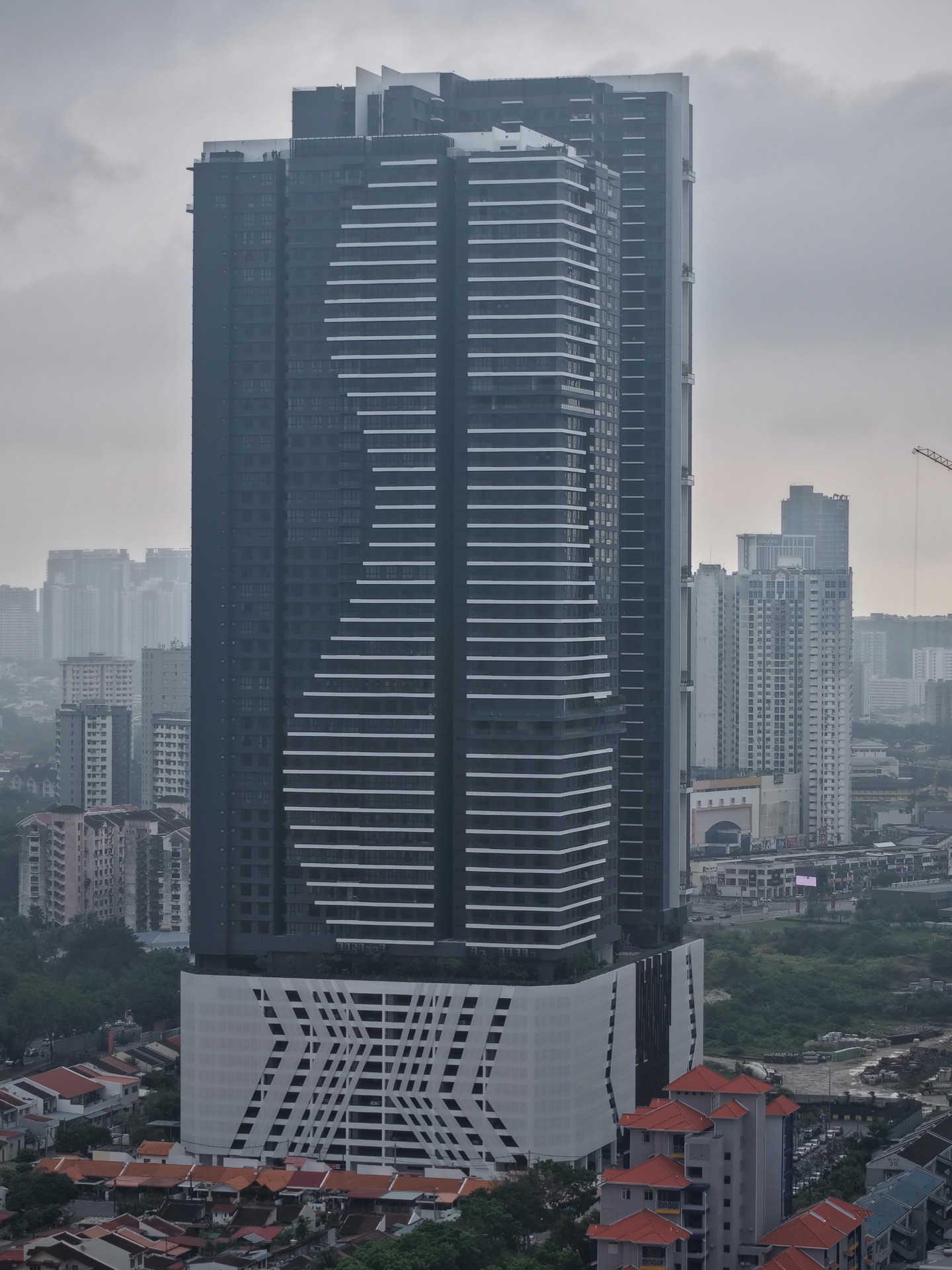
Read your SPA carefully: the delivery clause commits your developer to 48 months from signing. That's 4 years — the honest number you're agreeing to, whatever the sales gallery said about "30 months typical". Most Penang high-rises do deliver earlier — 30 to 36 months from SPA is the pattern I see. But 4 years is what's in your contract, and it's what your LAD claim is measured against. Here is every stage, in order, with what you pay, what you get, and where I've seen people lose money by rushing.
Key takeaways:
- Your SPA typically commits the developer to 48 months (4 years) from SPA signing for delivery. Most deliver in 30–36 months in practice — but the SPA is the contract you can enforce.
- Total from sales gallery to keys: budget 4 years. Add another 6–12 months for MOT once the strata title issues, and strata title itself can lag VP by several years.
- Upfront cash by SPA signing: 10% down + legal + stamp duty. For foreigners, stamp duty is a flat 8% of the purchase price — not the tiered citizen scale.
- State consent (COSA) takes 3–4 months in Penang. It runs alongside construction, so it doesn't push out keys — but it does gate MOT and title.
- Six decisions are effectively irreversible: which unit you book, the SPA terms you accept (LAD, DLP, delivery date, stakeholder account, extension of time clauses, the finishes schedule), and your loan structure.
- The 24-month Defect Liability Period starts on VP, not on strata title — miss the deadline and you pay for defects the developer should have.
The full timeline at a glance
| Stage | Timing | What you pay | What you get |
|---|---|---|---|
| VIP registration & shortlist | Month 0–1 | RM0 (usually) | Pre-launch pricing, first pick of stack |
| Sales gallery visit | Month 1–2 | RM0 | Price list, floor plan, unit availability chart |
| Booking / reservation | Month 2 | 2–5% earnest deposit | Reserved unit, 14–21 days to sign SPA |
| Loan in-principle | Month 2–3 | RM0 (application) | Bank confirmation of your borrowing capacity |
| Sign SPA + 10% down | Month 3 | Balance to 10% + legal + stamp duty | Signed Schedule H contract |
| State consent (foreigners) | Month 3–6 | RM10k–20k legal + application | COSA approval to complete the purchase |
| Progress billings | Month 4–30 | Schedule H drawdowns | Construction milestones |
| Vacant Possession (typical) | Month 30–36 | Retention sum released (2.5%) | Keys, DLP starts |
| Vacant Possession (SPA deadline) | Month 51 (SPA + 48m) | LAD triggered if late | Contractual delivery point |
| MOT + strata transfer | Month 36–48+ | 8% stamp duty (foreigners) + MOT fees | Registered title in your name |
| DLP window closes | 24 months after VP | Nothing extra | End of developer's defect obligation |
The typical timing above assumes a standard Penang island Schedule H project that delivers on the fast end of the range. The SPA-stated 48-month deadline is what your LAD claim runs against, so track both. Landed housing under Schedule G is faster on paper (24-month statutory build) but rarely faster in practice.
Month 0–1: Pre-launch registration and shortlisting
The best pricing on a Penang new launch is almost never at the sales-gallery reveal — it's at the private VIP preview two to eight weeks earlier. Every serious developer runs one. To get in you register early, ideally through an agent who works the project, and you tell them your stack preference (facing, floor band, unit size) before there's public marketing to react to.
What's actually negotiable at pre-launch: unit choice (biggest lever), rebate structure, freebie package (usually SPA + loan legal fees, sometimes furniture credit), and occasionally the SPA delivery date on later phases. What is not negotiable: the headline price on Schedule H projects, and the standard Schedule H clauses themselves — those are statutory.
The mistake to avoid: registering with three agents at three different developers. You want one person tracking your shortlist so the developer sees a single, real buyer — not three noisy leads that get deprioritised.
Month 1–2: The sales gallery visit
Bring your IC or passport, your calculator, and a written question list. Do not bring your chequebook.
The gallery visit is not the moment to book. It is the moment to (a) confirm the unit really exists on the availability chart, (b) walk the show unit and check ceiling heights, corridor widths, and where the aircon compressor lives on your floor plan, and (c) get the developer's written price list and payment schedule to take home.
The common traps I see:
- Show unit finishes are upgraded — the standard SPA specifies base finishes. Ask for the standard spec sheet, not the show unit.
- "Free" legal fees usually apply only if you use the developer's panel lawyer. That's fine on the SPA; be more careful on the loan side, because a panel lawyer represents the bank, not you.
- The rebate is often built into the price. A "12% rebate" on RM1.5M that started life at RM1.32M is just marketing.
See Penang subsale vs new launch (2026) for how these gallery-day numbers compare to buying a comparable resale unit today.
Month 2: Booking and the earnest deposit
You sign a reservation form and pay a booking fee of 2–5% — RM30,000 to RM75,000 on a RM1.5M unit is typical. You get 14 to 21 days to sign the SPA.
Malaysia has no statutory cooling-off period on new-launch purchases. Whatever the reservation form says about refunds is what governs — read it before you sign, not after. Most reservation forms let you walk with a full refund only if the bank turns down your loan (documented) or if the developer fails to deliver a signable SPA within the reservation window.
Practical rule: never pay the booking fee unless you have already run the loan sums against two banks informally and both said yes.
Month 2–3: Loan in-principle
Banks assess a new launch differently from a subsale. On a subsale they lend against the valuation report; on a new launch they lend against the developer's price list plus their own risk view of the project (Is the developer proven? Is the location liquid? Is the density reasonable?). Two identical-income buyers can get different LTVs on the same unit from the same bank in different months.
The two-bank rule: apply to at least two banks in parallel. You want a real comparison of interest rate, LTV, and lock-in period, and you want a backup if one bank changes its risk view mid-process.
Foreign buyers should assume roughly 70% LTV, not the 90% citizens can access. That materially changes the cash-in — use the affordability calculator with your actual foreign-buyer LTV assumption before you pick a unit.
Month 3: Sign the SPA and pay the balance of 10%
The Schedule H SPA is a statutory contract. Ninety percent of it is fixed by the Housing Development Act 118 and cannot be varied. The ten percent that can be varied is where most buyers underread. The six clauses I always slow buyers down on:
- Delivery date (Clause 25 / Schedule H item 27) — the calendar date, not a vague quarter. This starts the LAD clock.
- LAD rate — statutory at 10% per annum of the purchase price for late delivery. Confirm it hasn't been re-drafted.
- Defect Liability Period — statutory 24 months from VP. Confirm no attempt to shorten it.
- Stakeholder account — 5% of the purchase price is held for 8 months post-VP (2.5% for 8 months and 2.5% for 24 months in the standard Schedule H). This is your leverage on defects; don't waive it.
- Extension of time / force majeure — check what triggers an EOT. A wide EOT clause makes the delivery date almost meaningless.
- Finishes schedule — the SPA annex. If it says "or equivalent", know that the developer decides "equivalent".
At signing you top up from the booking fee to the full 10% down, and you pay the SPA legal fees (often waived by the developer) and the SPA stamp duty. Loan stamp duty is separate and comes with the loan documents.
For the acronym-heavy vocabulary here — SPA, DLP, VP, LAD, CCC — the glossary has plain-English definitions.
Month 3–6: State consent (foreign buyers only)
Every foreign purchase in Malaysia requires Consent of State Authority (COSA). In Penang, the application is filed by your conveyancing lawyer immediately after the SPA is signed and takes 3–4 months to grant — not the 4–8 weeks some agents still quote.
State consent runs in parallel with construction, so it almost never pushes out your delivery date. What it does do:
- Delays your MOT and title transfer until it's granted.
- Adds RM10,000–RM20,000 in legal and application fees.
- Requires the standard foreign-buyer documentation (passport, source of funds evidence, remittance trail if funds are already in Malaysia).
If you're a foreign buyer, work through the foreign-buyer checklist before you sign the SPA — it lists every document the lawyer will ask for and the ones people scramble to source at the last minute.
Month 4–30: Construction and progress billing
Under Schedule H, payments are drawn down in stages tied to construction milestones — foundation, structure, brickworks, roofing, internal finishes, external works, CCC. Each drawdown is certified by the developer's architect and released by your bank against a progress claim; you don't cut cheques, the bank does.
Two things buyers should still do during this "quiet" period:
- Visit the site every 4–6 months. Not to interfere, but to see that construction is actually where the payment schedule says it is. If billing is running ahead of visible progress, ask your lawyer to write to the developer.
- Document delays in writing. If the developer misses a milestone, an email from you (or better, your lawyer) to the developer creates the paper trail you'll need if you eventually file for LAD.
Month 30–32: Vacant Possession — the defect inspection matters more than the keys
VP is triggered by the CCC (Certificate of Completion and Compliance) being issued. The developer sends you a notice of Vacant Possession; you have 14 days to inspect and take delivery.
Do not accept the keys until you've done a proper defect inspection. Once you sign the VP acknowledgement, the DLP clock starts (24 months) and anything you list as a defect must be logged before you sign. A checklist inspection with a paid third-party inspector costs RM800–RM2,000 and consistently finds RM10,000–RM40,000 worth of defects on a mid-market Penang unit — hairline cracks, uneven tiling, drainage falls, aircon condensate leaks.
On the day you take VP:
- The developer releases the balance of the retention sum according to the Schedule H schedule.
- Your DLP starts — you now have 24 months to raise defects.
- You can move in, rent out, or list for sale (as an assignment).
Month 32–36+: MOT and strata title
The Memorandum of Transfer registers the title in your name and triggers the 8% flat foreign-buyer stamp duty (citizens pay the tiered 1–4% scale). MOT can only happen after the strata title is issued, and strata title in Penang commonly lags VP by 2–5 years — sometimes longer for large or phased projects.
During that gap you hold the property under a Deed of Assignment. That's a normal, marketable position — you can rent, sell, and refinance on a DA — but the MOT stamp duty is a real cash outflow you should reserve for. On a RM1.5M unit, 8% is RM120,000 that lands whenever the strata title comes.
Year 2 post-VP: the DLP deadline that ends the developer's obligation
The 24-month Defect Liability Period ends on the second anniversary of VP. Anything you raise on day 731 is at your own cost. In practice:
- Do a formal defect walk-through at month 12 and again at month 22. Between them you'll have lived in the unit through two full monsoon cycles — you'll know where the water gets in.
- Every defect notice goes in writing, dated, with photographs, to both the developer and the property manager.
- If the developer stops responding, your lawyer can draw down against the retention sum still in the stakeholder account.
If the developer delivered late, this is also when the LAD claim gets finalised — statutory 10% per annum on the purchase price for the days between the SPA delivery date and actual VP.
What you actually pay along the way
For a RM1,500,000 island unit bought by a foreign buyer with 70% LTV:
| Stage | Cash out | Running total |
|---|---|---|
| Booking (5%) | RM75,000 | RM75,000 |
| SPA — balance to 10%, legal (often waived), SPA stamp duty | ~RM40,000 | RM115,000 |
| State consent legal + application | ~RM15,000 | RM130,000 |
| Penang 3% foreign-buyer levy on Island (payable near SPA) | RM45,000 | RM175,000 |
| Progress billings (funded 70% by loan, 20% cash) | RM300,000 over 26 months | RM475,000 |
| MOT stamp duty (8% foreign) when strata issues | RM120,000 | RM595,000 |
That's roughly RM595,000 in cash and cash-equivalents across the full timeline, before you count monthly loan servicing during the construction period. The true cost of buying Penang property as a foreigner breaks the same numbers down clause by clause, and the RPGT calculator shows what you'll owe if you exit within the first five years.
The six decisions you cannot reverse
- Which unit you book. Assignments before completion are possible but costly.
- The SPA delivery date and LAD wording. After signing, the clock is the clock.
- The DLP duration. Statutory is 24 months; make sure the SPA hasn't quietly shortened it.
- Which bank funds the loan and at what LTV. Refinance is possible later but costs money.
- The finishes schedule annexed to the SPA. "Or equivalent" is decided by the developer.
- Whether you accept VP without a proper defect inspection. Signing the VP acknowledgement is signing away leverage.
The other 80% of the process is procedural. Where I add value is on those six.
The honest close
Most Penang new-launch buyers I meet were not walked through this timeline before they signed. They signed because the sales gallery was beautiful, the rebate looked large, and the payment schedule felt slow enough to feel affordable. Two years later they were surprised by the stamp duty on MOT, or the LAD claim they didn't file, or the defects they missed because they took keys the same day they collected them.
If you want me to walk you through this for a specific project — reviewing the reservation form before you sign it, running the loan numbers against two banks, sitting in on the SPA signing, and doing the VP inspection with you — that's the job. WhatsApp me the project name and I'll tell you honestly whether it's the right one for you, or whether the subsale two floors down is a better deal.
Sources
- Housing Development (Control and Licensing) Act 1966 (Act 118), Schedules G and H
- Penang State foreign-buyer thresholds and levy rules (Penang Structure Plan 2030 / State Authority notices)
- Standard Malaysian SPA / Deed of Assignment conveyancing practice
- LHDN / IRB stamp duty and RPGT rate tables (2026)